


Results & Analysis







FAMU - FSU College of Engineering Updated 4.2007





Test Results
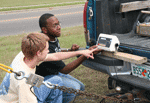
Through repeated testing the team was able to determine all objectives with reasonable accuracy. Tests included three separate weight values used as the mock rider and recorded tension readings based on a certain wind speed measured by a hand held anemometer. The weights used for the test were 90, 125, and 230 lbs. In order to record the data accurately, two team members operated in unison, recording the wind speed and tension reading at the same moment the parasail appeared to be flying in a level fashion with the rope at approximately 40 degrees above horizontal. This proved difficult but possible even though several factors created less than ideal testing conditions. The uneven terrain provided one source of possible error as measurements could only be taken at a time when the truck was not rising or dropping quickly in a manner that affected the tension of the tow line. Additionally, the wind varied in speed and the parasail seldom flew in a perfectly level manner. Readings could not be taken when the parasail was rising or descending since this would indicate that the condition was not steady state and therefore the readings would not yield the correct wind speed to lift correlation.
Analysis
The theoretical calculations indicated that a wind speed of 8 miles per hour would provide just over 140 lbs of lift. The theoretical calculations also show that for a wind speed of 25 miles per hour, the tension on the tow line would be approximately 3,000 lbs. However, our maximum wind speed test at 25 miles per hour resulted in a measured tension of 2200 lbs with the 230 lb weight attached. This indicates that the total un-weighted tension would be closer 2300 lbs.
The parasail was found to have a drag coefficient of slightly less than the estimated value. The textbook drag coefficient for a parachute is about 1.3 while the test showed a drag coefficient of approximately 1.2 for the two out three most accurate tests. The drag coefficient was very high at 1.7 for the 90 lb test weight. A likely reason for this is that the drag coefficient seemed to decrease as wind speed increased. The wind speeds for the 90 lb test included values of below 10 mph with abnormally high tension readings. These raised the value for the average drag oefficient. These results could be erroneous due to bad recording conditions but it is also possible that the behavior of the parasail is not as predicted in the theoretical calculations. If the drag coefficient of the parasail does in fact decrease with an increase in wind velocity, this could be very beneficial for the safety of the entire system. A dangerous high velocity gust would have a lesser effect than what was previously expected. For the purpose of safety, however, it will be assumed that the drag coefficient will not decrease below the value recorded at our maximum test speed of 25 miles per hour.
Through repeated testing the team was able to determine all objectives with reasonable accuracy. Tests included three separate weight values used as the mock rider and recorded tension readings based on a certain wind speed measured by a hand held anemometer. The weights used for the test were 90, 125, and 230 lbs. In order to record the data accurately, two team members operated in unison, recording the wind speed and tension reading at the same moment the parasail appeared to be flying in a level fashion with the rope at approximately 40 degrees above horizontal. This proved difficult but possible even though several factors created less than ideal testing conditions. The uneven terrain provided one source of possible error as measurements could only be taken at a time when the truck was not rising or dropping quickly in a manner that affected the tension of the tow line. Additionally, the wind varied in speed and the parasail seldom flew in a perfectly level manner. Readings could not be taken when the parasail was rising or descending since this would indicate that the condition was not steady state and therefore the readings would not yield the correct wind speed to lift correlation.
Analysis
The theoretical calculations indicated that a wind speed of 8 miles per hour would provide just over 140 lbs of lift. The theoretical calculations also show that for a wind speed of 25 miles per hour, the tension on the tow line would be approximately 3,000 lbs. However, our maximum wind speed test at 25 miles per hour resulted in a measured tension of 2200 lbs with the 230 lb weight attached. This indicates that the total un-weighted tension would be closer 2300 lbs.
The parasail was found to have a drag coefficient of slightly less than the estimated value. The textbook drag coefficient for a parachute is about 1.3 while the test showed a drag coefficient of approximately 1.2 for the two out three most accurate tests. The drag coefficient was very high at 1.7 for the 90 lb test weight. A likely reason for this is that the drag coefficient seemed to decrease as wind speed increased. The wind speeds for the 90 lb test included values of below 10 mph with abnormally high tension readings. These raised the value for the average drag oefficient. These results could be erroneous due to bad recording conditions but it is also possible that the behavior of the parasail is not as predicted in the theoretical calculations. If the drag coefficient of the parasail does in fact decrease with an increase in wind velocity, this could be very beneficial for the safety of the entire system. A dangerous high velocity gust would have a lesser effect than what was previously expected. For the purpose of safety, however, it will be assumed that the drag coefficient will not decrease below the value recorded at our maximum test speed of 25 miles per hour.